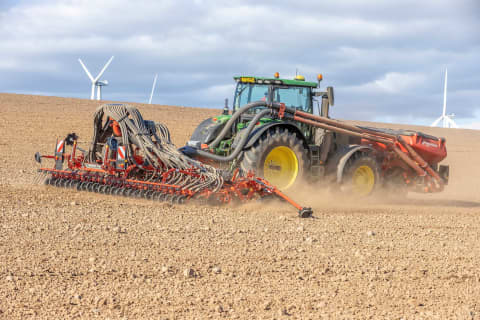
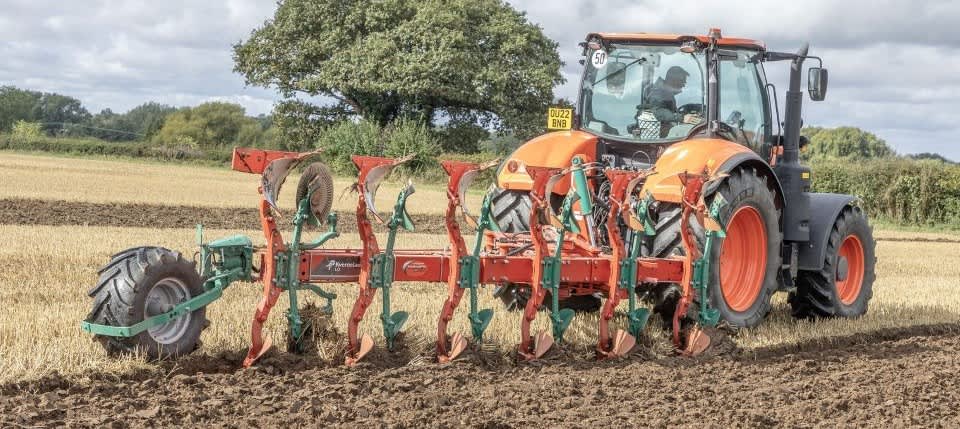
In certain circles, ploughing seems to have become public enemy number one when it comes to soil health. But has this long-standing cultivation method really had its day, or does it still provide a practical solution for establishment on many farms?
Ploughing is often viewed as a clean start, burying weed seeds below their emergence depth - a strategy that can help deplete grassweed burdens within the soil seed bank.
Agronomist View - Kathryn Richards, Agronomist at ProCam

Kathryn Richards, Agronomist at ProCam, suggests that understanding the lifecycle of grassweeds is vitally important for long-term control.
“Creating an integrated plan to manage a grassweed burden is important, as although many non-chemical control methods provide some solutions in isolation, none provides complete control.
“Burial of weeds can sometimes save a glyphosate application, but it can be very weed-dependent.
“Ploughing holds a place in the inversion of diseases, for example fusarium, which is increasingly prevalent after maize. Burying the stubble reduces the carry-over to the subsequent wheat crop, for which fusarium is a high-risk disease.
“Choosing the right establishment method for the region, soil type and weather is so important. A strong, healthy crop is needed to compete against any type of weed burden, especially grassweeds.
“Minimal tillage and no-till can be excellent establishment methods. But when the weather turns unfavourable, establishing a crop that struggles with poor coverage throughout autumn and early spring, even with the best pre- and post-emergence spray programme - means grassweeds will often thrive. Outcompeting the crop for space and nutrients, and hindering yields and profitability,” she adds.
AHDB figures suggest high-quality ploughing, with good inversion of the furrow, can provide up to 70% control of grassweeds.
When ploughing, it is important that trash is buried correctly to a depth of 5cm or more.
Strategic Use - Craig Patrick, AHDB Knowledge Exchange Manager

Craig Patrick, AHDB Knowledge Exchange Manager – Cereals & Oilseeds, says: “I like to see the plough being used strategically, alongside reduced tillage, while maintaining an active root in the soil where possible.
“Rotation ultimately plays a part in the use of the plough, with root crops requiring more soil movement.
“Rotational ploughing every three to six years can help alleviate compaction to plough depth in the right conditions.
“However, frequent ploughing can return buried weed seeds to the surface.
“This frequency can also lead to other issues. High levels of soil disturbance destroy the natural supportive structure of the soil.
“Oxidising organic matter reduces soil resilience and increases the risk of mineralised nutrients being lost to the atmosphere, accelerating soil degradation,” he adds.
Consolidation
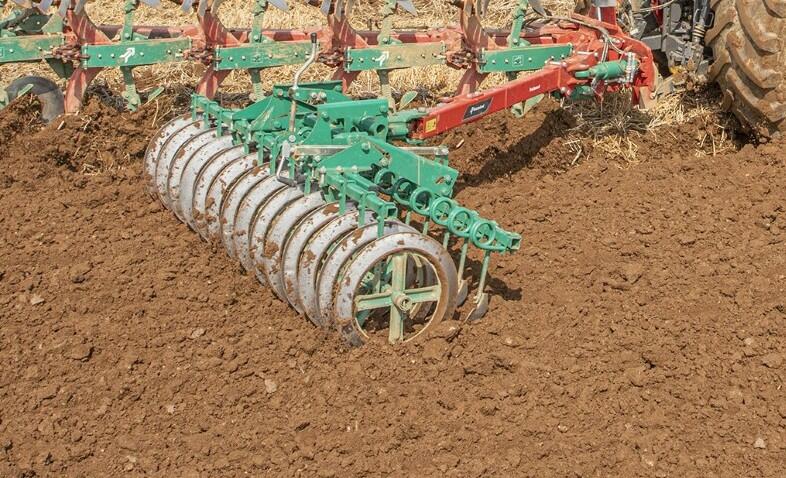
A furrow press provides a cost-effective reconsolidation method in light soils. |
AHDB suggests using a press for consolidation to help mitigate some organic matter loss through oxidation, while providing better support for subsequent field traffic.
Ploughing can be a time-consuming and costly operation if poorly planned, so ensure soil conditions are right and settings are correct to suit soil type — not simply tractor capacity.
Depending on farm practice, fields under a no-till system can build high phosphate levels in the top two inches of soil. In these situations, ploughing once every 10 years may be a viable solution to redistribute nutrients through the soil profile.
Plough Choices - Adam Burt, Kverneland product manager

Adam Burt, plough product manager at Kverneland, says: “When considering a mounted plough, it is always important to match the plough to the tractor. Both horsepower and lift capacity are important.
“Plough weight is one thing, but plough lift requirement is another. Typically, a five-furrow plough weighs around 1,700kg but would have a lift requirement of approximately 5,200kg.
“All Kverneland bodies are designed as universal and will work in all soil types, ploughing at furrow widths from 12 to 24 inches.
“Full-body mouldboards for general-purpose work in light, medium and heavy soils, giving full inversion at depths of five to 16 inches. Kverneland body No.28 suits five to 12 inches, and Kverneland body No.38 suits five to 16 inches.
“Slatted or finger bodies also work in light, medium and heavy soils, helping to increase soil flow in sticky or loose conditions.
“The Kverneland No.40 body will give a more broken furrow in medium to heavy soils.
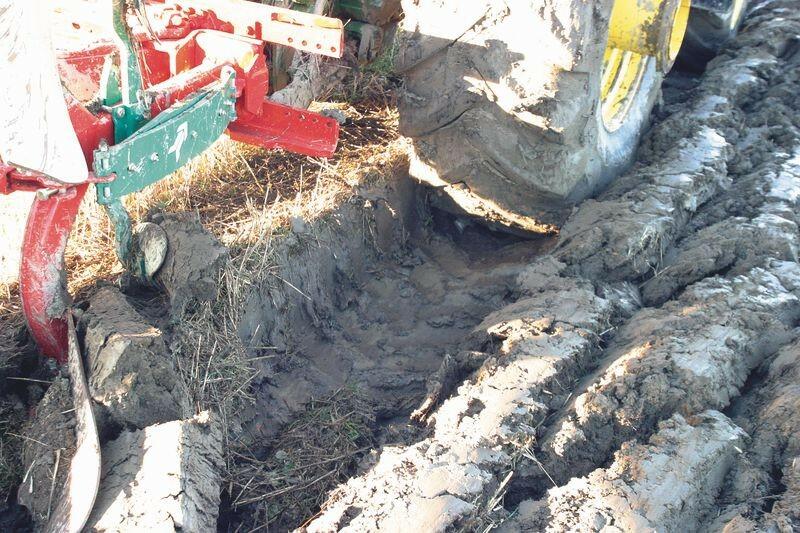
“Tyre size is also an important consideration when purchasing a plough. Tyres from 650 to 710 can plough in-furrow with a No.28, No.38 and No.40 body, but anything wider — or tracks — will require an on-land plough.
“On-land ploughing is also preferable for operators considering ploughing with a guidance system, as guidance requires the ability to move both left and right to remain straight.”
Kverneland’s mounted on-land in-furrow plough range offers tractor flexibility across five-seven furrow formats |
Kverneland first introduced ISOBUS control to its plough range in 2003, adding a new level of sophistication to ploughing technology.
“Key user benefits include on-the-move adjustment and memory functions, allowing different settings to be set and saved for different fields and tractors,” Adam adds.
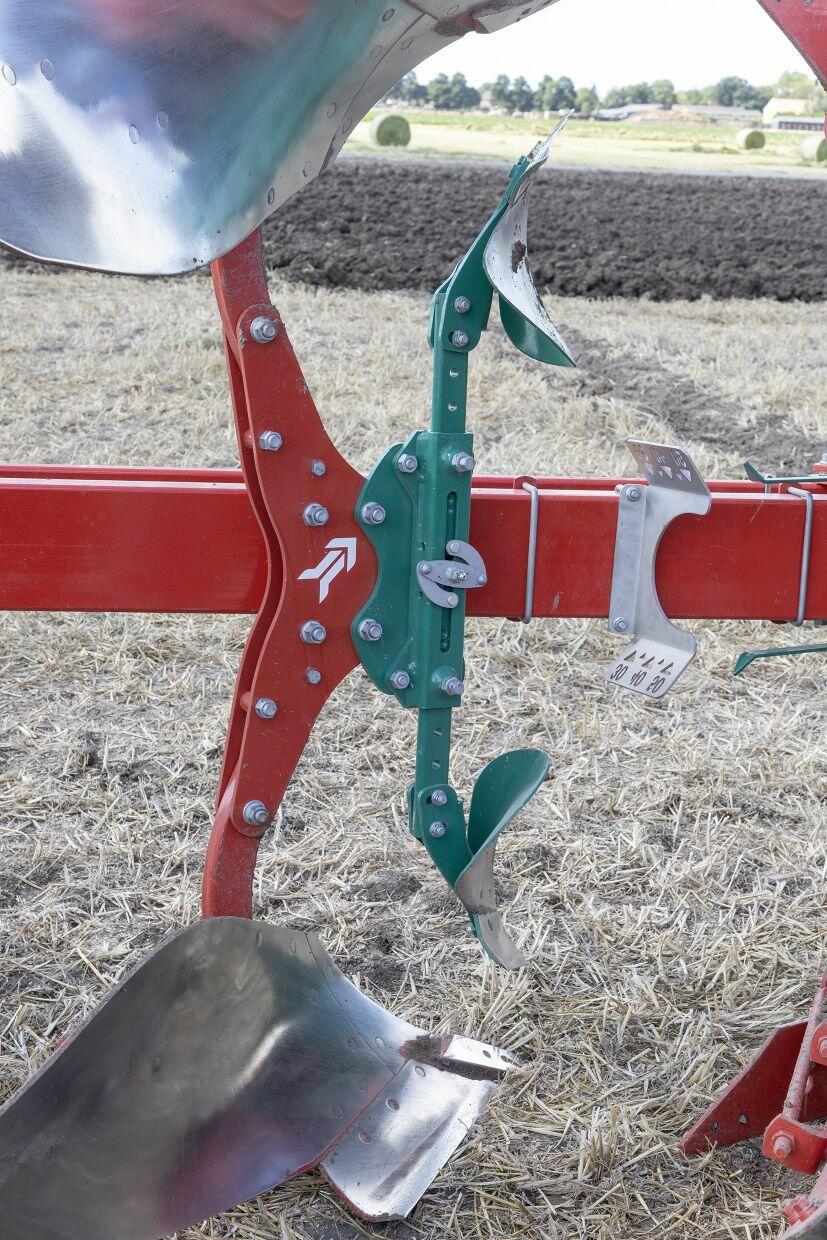
Manure skimmers perform better in light stubbles, while maize skimmers offer better performance in heavy trash situations |
Adam says: “Plough alignment is vital. The plough needs to pull straight for the bodies and skimmers to run at the correct working angle — in the case of a Kverneland body, that is 38 degrees.
“Ensure the beam is running level to allow the same amount of soil to pass across all bodies.
“When adjusting the front furrow, make sure it matches the width of the other furrows.”
“Choosing the correct forward speed for the soil type and conditions is also important. The skimmers need enough time for trash to reach the bottom of the furrow to ensure good, consistent soil coverage, he adds.”
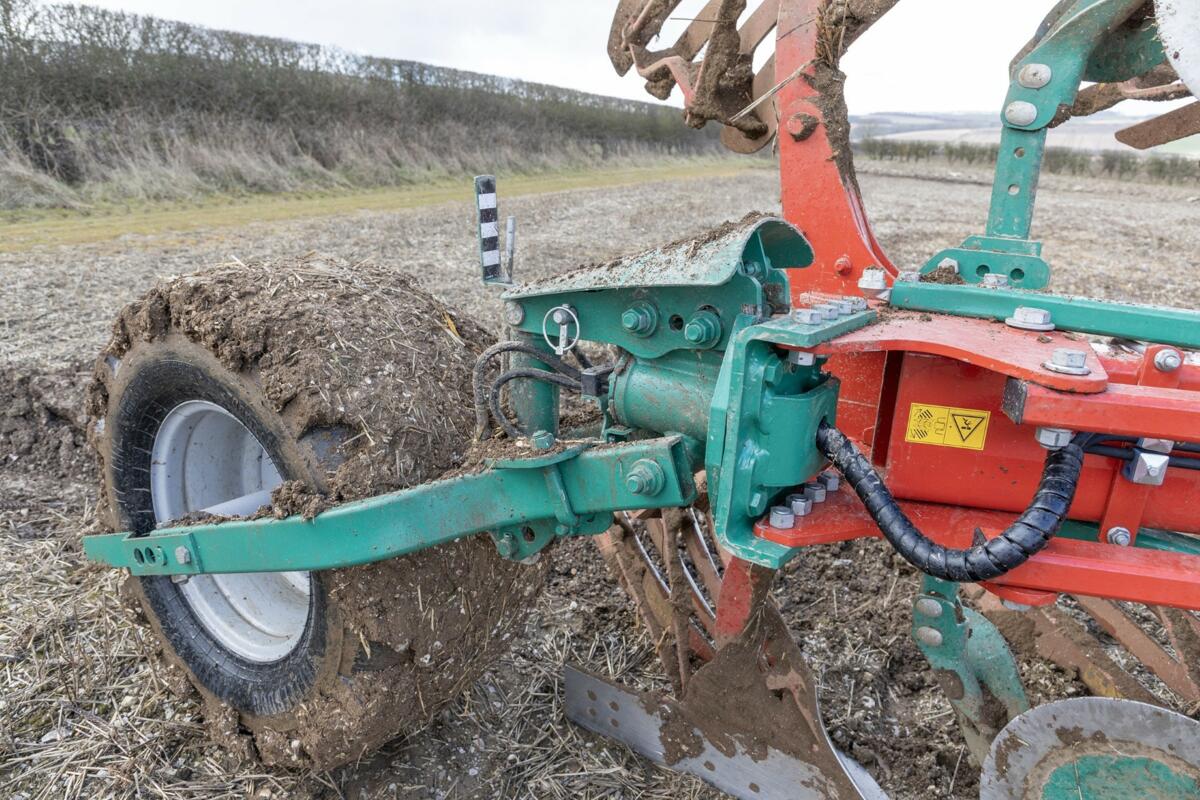
A wider depth wheel is often needed on lighter soil types and wet conditions to support the plough
Article written and supplied by Tillage & Soils magazine, March/April 2026 issue.